
A solo creator can draft a release checklist in StackEdit without signing in, see the Markdown render beside the source, reload the tab and export the note. Our 267-byte test survived one reload and the exported text matched after accounting for a three-byte UTF-8 byte-order mark. The catch is more important than the convenience: browser persistence is not a backup, and one unescaped table character hid part of a handoff instruction from the preview.
Verdict for a short creator handoff
StackEdit worked for the narrow job we tested: write a small, readable Markdown note, check its structure visually, and save a plain-text copy before handing it to someone else. It is a useful scratch editor when the destination is a README, issue, repository or publishing system that already accepts Markdown.
It is a poor sole home for a release record. Our reload check proves one file persisted in one browser session; it says nothing about cleared site data, another device, private browsing or long-term recovery. We also did not verify what network requests may include document content. Do not paste a confidential client brief on the assumption that “browser based” means “local only.”
The reader task and the acceptance test
The test persona was a solo video creator preparing a launch note for an editor. The note had to keep four kinds of structure: a title, task states, a delivery deadline and a two-column asset table. The minimum acceptable result was a matching preview, recoverable source after reload and an export that retained the literal Markdown.
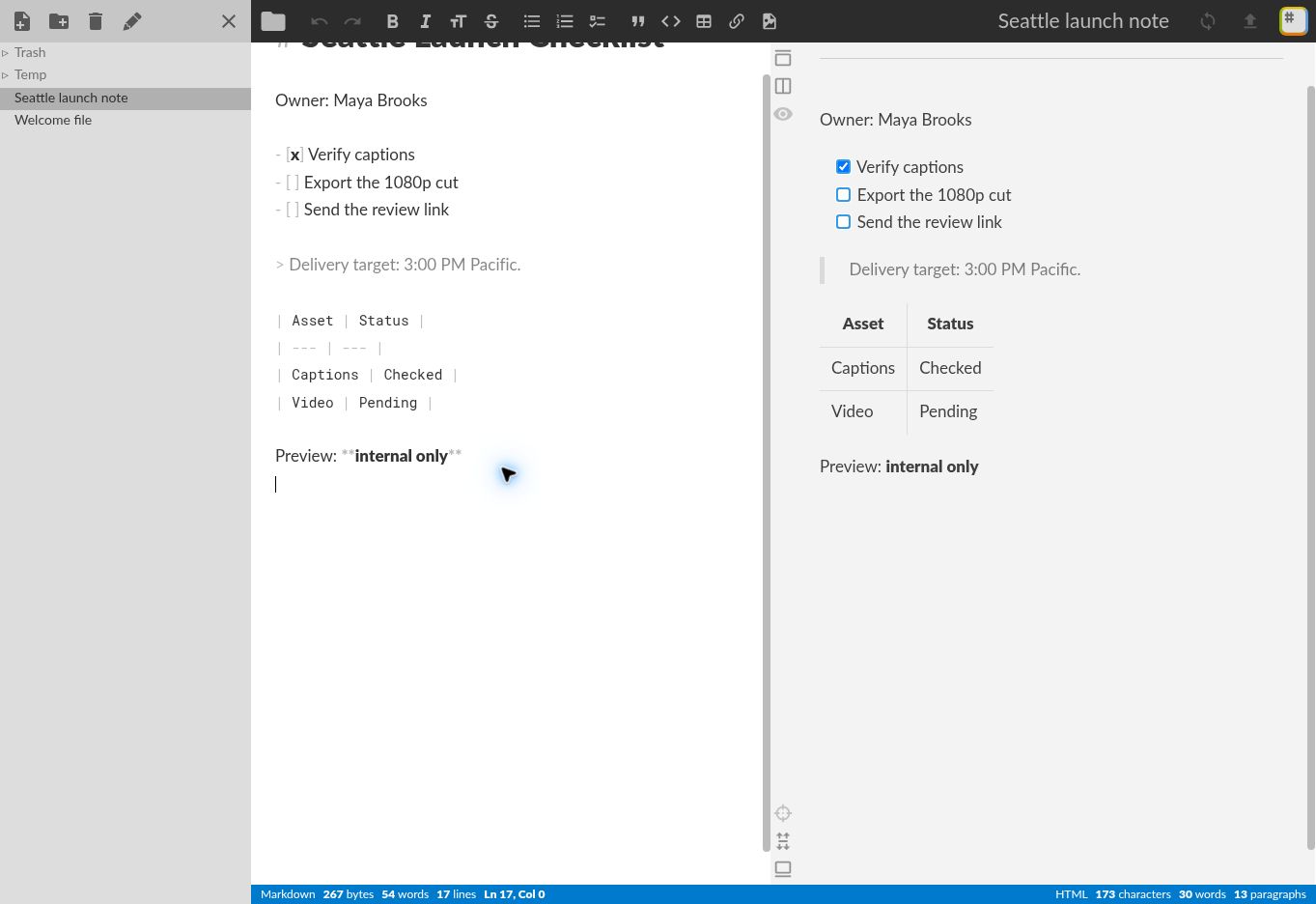
# Seattle Launch Checklist

Owner: Maya Brooks

- [x] Verify captions
- [ ] Export the 1080p cut
- [ ] Send the review link

> Delivery target: 3:00 PM Pacific.

| Asset | Status |
| --- | --- |
| Captions | Checked |
| Video | Pending |

Preview: **internal only**
Testing used the public StackEdit web app in a desktop Chrome cloud browser on October 14, 2026. We created a new file, renamed it “Seattle launch note,” replaced the starter attribution with the fixture, inspected the preview, reloaded the page and used the Import/export menu. No account, paid plan, private recording or external sync provider was used.
Live preview caught structure, not intent
The valid fixture rendered the heading, all three tasks, the blockquote, the two-column table and the bold phrase. The status bar reported 267 Markdown bytes, 54 words and 17 lines. This was a direct observation of this sample, not a performance benchmark.
The split view was the useful part. A creator can see that a checkbox is actually a checkbox and that a table has the intended columns before copying the note elsewhere. Formatting buttons for headings, lists, checks, quotes, code, tables, links and images were visible, but the review did not treat their presence as evidence that every workflow works.
There was small interaction friction. Selecting all text worked only after the editor pane had focus; clicking around the surrounding interface first did not reliably make a copy command return text in our browser automation. Reading the editor source directly confirmed the fixture’s whitespace and delimiters, but clipboard fidelity remained unverified.
Reload persistence passed once
After a normal page reload, StackEdit reopened the file named “Seattle launch note” with the same heading, owner, task states, blockquote, table rows and bold phrase. The editor still reported 267 bytes. That is useful protection against an accidental refresh during a short edit.
It is not evidence of a backup. StackEdit’s own welcome documentation says files are stored in the browser and saved locally. Browser storage can be cleared, and we did not test a different browser profile, device migration, private-window shutdown or a browser-storage reset. For any handoff that must be recoverable, export the .md file and keep it in a location with a backup policy you understand.
The Markdown export preserved the note, with a BOM
The Import/export panel offered “Export as Markdown.” The downloaded file was 270 bytes and had SHA-256 f7e9671bc77a7da73506af85aa62a669ff5765417f7940f17c6e84df7e084a08. Its first three bytes were a UTF-8 byte-order mark. Removing that mark left 267 bytes; the remaining text matched the source shown in the editor, including blank lines, checkboxes, table delimiters and emphasis markers.
A BOM is valid in many UTF-8 readers, but some strict scripts or comparison tools treat it as an extra character. If the next step is a build pipeline, parse the file as UTF-8 and make an explicit decision about the BOM instead of assuming the download is byte-for-byte identical to an existing repository file.
We did not test HTML, PDF or Pandoc export. The menu marked PDF and Pandoc routes as sponsored, and those outputs were outside this task. We also did not connect Google Drive, Dropbox or GitHub. Those integrations are documented by StackEdit, not observed in this review.
A single pipe character can hide the important words
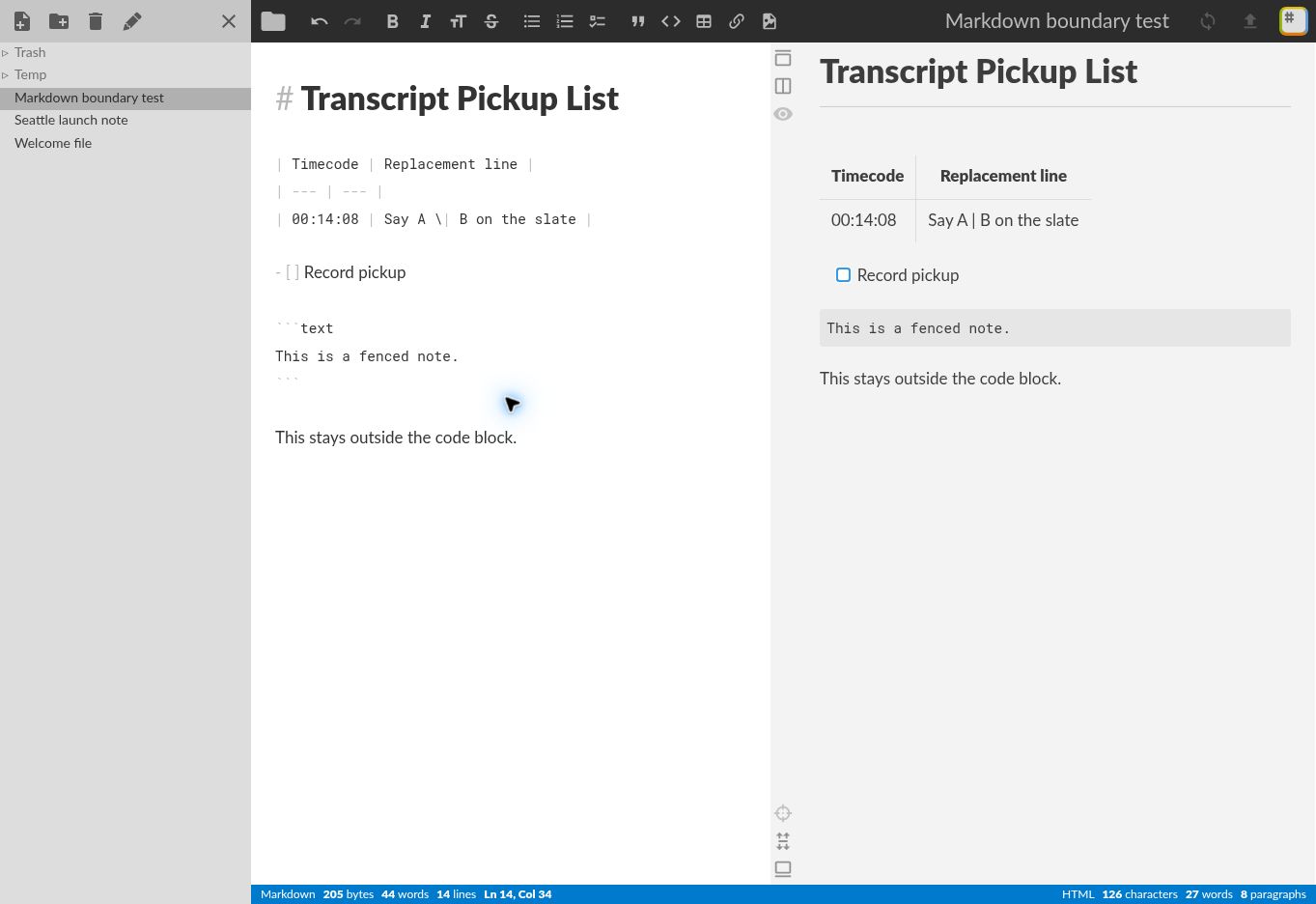
The boundary test used a transcript-pickup table. We entered this row:
| 00:14:08 | Say A | B on the slate |The preview kept “Say A” in the second cell but omitted “B on the slate.” The source still contained every character. That mismatch matters because the rendered handoff can look clean while silently dropping the part after the extra delimiter.
Escaping the literal pipe fixed the preview:
| 00:14:08 | Say A \| B on the slate |The corrected table showed “Say A | B on the slate” in one replacement-line cell. We also left a fenced code block open during the boundary test. Later Markdown was absorbed into that code block until the closing fence was restored. StackEdit did not invent the errors; it rendered the markup we supplied. The lesson is to compare source and preview where punctuation is content, especially in transcript quotes, shell examples and tables.
Free access is clear; long-term maintenance is not
The public editor accepted this test without an account or payment. The official landing page describes StackEdit as open-source, and the official repository carries an Apache-2.0 license. We found no official paid plan or per-seat allowance for the core editor, so there is no meaningful monthly-versus-annual price comparison to make here.
That does not make connected services costless. A Google Drive, Dropbox, GitHub, WordPress or other provider may have its own account, limits and policies. We did not sign in, buy anything or test those services.
The maintenance signal deserves caution. The official repository’s activity view showed no recorded update after May 27, 2023 when checked. The landing page’s Privacy Policy link also returned an error page during our check. Neither fact proves the live editor is unsafe, but both reduce the evidence available for a sensitive or long-lived workflow. We therefore narrow the recommendation to disposable or exported drafts and do not recommend StackEdit for confidential material based on this test.
Who should use it—and who should not
StackEdit fits a creator or developer who already wants plain Markdown, needs a visual sanity check and will export the result promptly. It is especially practical for a release checklist, show-note draft or small handoff that will move into a repository or another managed system.
Avoid relying on it as the only record when recovery, audited revisions, access control or confidential handling is non-negotiable. We did not verify mobile layout, large files, offline operation, collaboration, provider synchronization, network privacy or cross-device recovery. Those are not implied passes.
Dillinger is another no-login browser Markdown editor with live preview and documented export options. Joplin is a broader installed note system with cross-device clients, but it would require a different installation and synchronization test. Neither alternative was tested in this review, so they are directions for evaluation rather than winners declared from a feature list.
What the test supports
The practical conclusion is narrow: StackEdit completed a small no-login Markdown drafting task, retained it through one reload and exported matching text after a detectable BOM. Its preview exposed a punctuation-sensitive table failure once we compared it with the source. That makes it useful as a checked drafting surface, not as proof of durable storage or private processing.
See the StackEdit product profile for the compact directory entry, official links and related ToolBrivio coverage.
Primary sources checked October 14, 2026: the official StackEdit site, the public editor and welcome documentation, and the official source repository. Both screenshots are our own test artifacts using fictional US-English data. They are not vendor marketing images.