
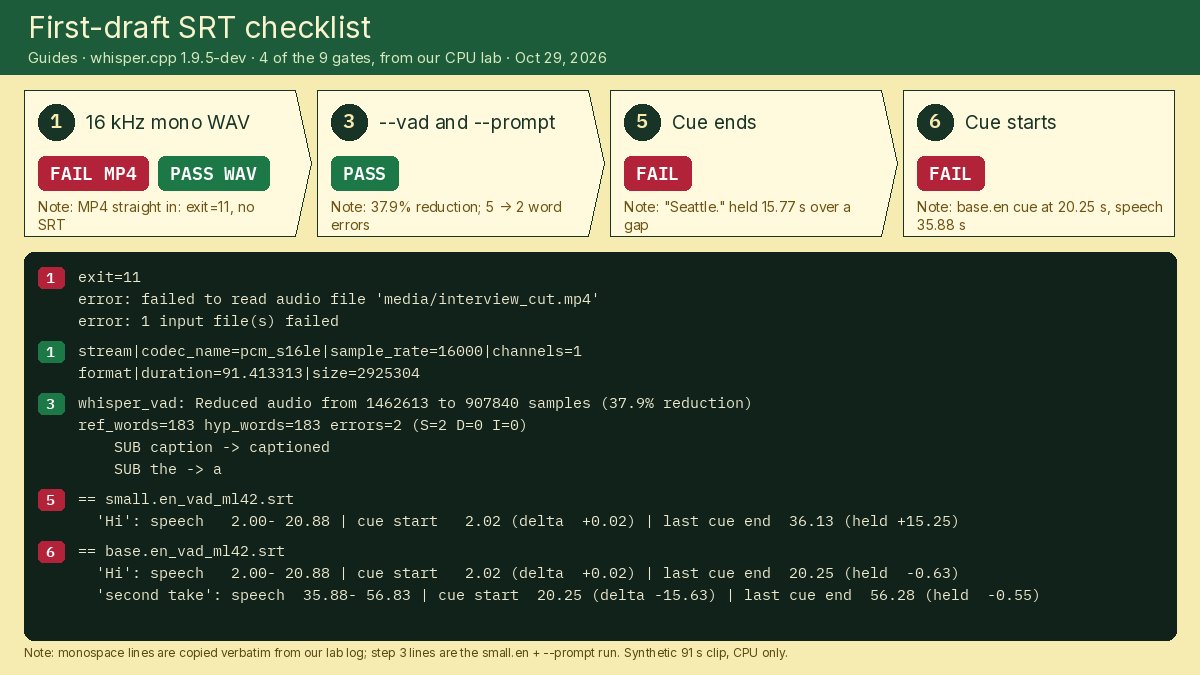
exit=11 and the 16 kHz WAV passed. Step 3: VAD cut 37.9% of the samples, and the prompt took small.en from 5 word errors to 2. Step 5: "Seattle." stayed up for 15.77 s over a gap. Step 6: base.en started a cue at 20.25 s for speech at 35.88 s. The lines in the dark panel are copied from our lab log.We have a locked interview cut, captions are due, and the audio should not leave the machine. This Guide is the pass we now run to get a first-draft SRT out of whisper.cpp on a CPU, and to decide whether that draft is fit to hand to an editor. Nine steps. Each one has a command and a PASS or FAIL call. Where our lab did not test something, the step says HOLD.
This is the short, pasteable version. Model timings, word-error counts and the full silence test live in the companion review: whisper.cpp review: an offline SRT first draft on a CPU, and the timing you still fix. We do not repeat those tables here.
Test note: October 29, 2026, Asia/Shanghai, Debian GNU/Linux 13 (trixie), KVM guest with 8 CPUs. whisper.cpp built from the official repo, commit 284029c, whisper-cli --version reports 1.9.5-dev. FFmpeg 7.1.5. CPU only. The test file is our own: a 183-word script read by a text-to-speech voice over a synthetic music bed, with a 15 s bed-only gap (20.88 to 35.88 s) and a 15 s digital-silence gap (56.83 to 71.83 s). It is not real interview audio.
The checklist
Persona: a creator or small post team with footage that should stay local, who wants an SRT to correct, not a finished caption file. Run the steps in order. One FAIL in steps 5 to 9 means the draft needs fixing before handoff, not that the run was wasted.
| Step | PASS | FAIL | HOLD |
|---|---|---|---|
| 1. 16 kHz mono WAV | ffprobe shows pcm_s16le, 16000 Hz, 1 channel, duration close to the source audio | MP4 fed straight to whisper-cli (ours: failed to read audio data, exit=11, no SRT) | File with several audio tracks: we did not test which track -map picks on a real camera file |
| 2. Model and threads | system_info: n_threads = 8 / 8 on an 8-core box | Default thread count left on a machine with more cores | Laptop CPUs, GPU builds (not tested) |
3. --vad and --prompt | Log shows Reduced audio from ... samples; listed names come out in the right case | Prompt names still misspelled in the SRT | Prompt on files longer than 91 s (not tested) |
4. -ml 42 -sow | Cue count roughly doubles, longest line near 42 | Lines still running to 90+ characters | Two-line captions: the flag does not make them |
| 5. Cue ends | No cue stays up through a gap with no speech | A one-word cue held for the whole gap (ours: 15.77 s) | No gap in your audio to test against |
| 6. Cue starts | First cue of each section starts at the speech, not at the gap | A cue starts when the gap starts (ours: 20.25 s for speech at 35.88 s) | |
| 7. Length and flashes | No line over 42 characters, no cue under 0.5 s | Any hit from the check script | |
8. [BLANK_AUDIO] and end time | No tag-only cue, last cue ends before the audio ends | [BLANK_AUDIO] running past the end (ours: 90.0 to 98.5 s on a 91.41 s file) | |
| 9. Names outside the prompt | Every proper noun checked by hand, not only the listed ones | Assuming the prompt covered everything | Accents, crosstalk, real guests (not tested) |
1. Convert to 16 kHz mono WAV
We fed our test MP4 (H.264 plus AAC, 48 kHz stereo) straight in first. It failed:
# our qc-recheck run, paths shortened, two info lines trimmed
$ whisper-cli -m ggml-base.en.bin -t 8 -f interview_cut.mp4 -osrt -of qc_mp4; echo exit=$?
read_audio_data: failed to read audio data
error: failed to read audio file 'interview_cut.mp4'
error: 1 input file(s) failed
exit=11
$ ls -l qc_mp4.srt
ls: cannot access 'qc_mp4.srt': No such file or directory
So convert first. Pick the dialogue track with -map if the file has more than one:
ffprobe -v error -show_entries stream=index,codec_type,channels -of compact interview.mp4
ffmpeg -i interview.mp4 -map 0:a:0 -vn -ar 16000 -ac 1 -c:a pcm_s16le interview_16k.wav
ffprobe -v error -show_entries stream=codec_name,sample_rate,channels:format=duration -of compact interview_16k.wav
Our converted file read back as pcm_s16le, 16000 Hz, 1 channel, 91.413313 s, 2,925,304 bytes. Our MP4 had a single audio track, so -map 0:a:0 was a no-op for us. On a camera file with a lav on one track and a scratch mic on another, change the index to the dialogue track and listen to the WAV before you go on. We did not test that case: HOLD.
Side note: we also fed the 48 kHz, 24-bit stereo master WAV directly. It was accepted, and diff -s reported "Files outputs/pitfall_48k.srt and outputs/base.en.srt are identical" against the 16 kHz run. We still convert every time, because MP4 failed and older builds may enforce the 16 kHz rule from issue #909.
- [ ] ffprobe shows 16000 Hz, 1 channel,
pcm_s16le - [ ] WAV duration close to the source audio
- [ ] Right track picked (listen to 10 seconds)
2. Pick a model, set -t to your core count
nproc
./build/bin/whisper-cli -m models/ggml-small.en.bin -t 8 -f interview_16k.wav -osrt -of draft 2>&1 | grep system_info
PASS when the system_info line reads n_threads = N / N with N equal to your cores. On our 8-CPU box the default ran 4 threads: base.en took 6.353 s that way, against 5.585, 5.667 and 5.200 s with -t 8. We draft with small.en because it gained the most from the name prompt in step 3. The per-model speed and error table is in the whisper.cpp review.
- [ ]
-tequals core count - [ ] Version noted (
whisper-cli --version) so later runs compare
3. Add --vad and a --prompt with the name list
./build/bin/whisper-cli -m models/ggml-small.en.bin -t 8 -f interview_16k.wav \
  --vad -vm models/ggml-silero-v6.2.0.bin \
  --prompt "Maya Delgado, Jordan Whitaker, ToolBrivio, Subtitle Edit, SRT." \
  -ml 42 -sow -osrt -of draft 2>&1 | grep -E 'Reduced audio|total time'
The Silero VAD model is one 885,098-byte download. On our file the log said Reduced audio from 1462613 to 907840 samples (37.9% reduction). That line is the PASS signal that VAD actually ran.
Put every name and product you expect in the prompt, spelled the way you want it on screen. With the prompt, small.en went from 5 word errors to 2, and all nine name and term checks came out in exact case, including "Subtitle Edit". base.en went from 12 to 5 but still wrote "Mia". A GitHub comment in issue #2140 says a plain prompt fades after the first window on longer audio. We only had 91 seconds: HOLD for long files.
- [ ] VAD line present in the log
- [ ] Every listed name spelled right in the SRT (grep for each)
4. -ml 42 -sow for line length
Already in the step 3 command. -ml 42 caps segment length in characters, -sow splits on word boundaries instead of tokens. With VAD, small.en went from 17 cues (longest line 91 characters) to 34 cues (longest 46). Treat 42 as a target. Each cue stays one line; merging into two-line captions is an editing job.
- [ ] Cue count went up
- [ ] Step 7 check run on the result
5. Check each cue end: does it hang over a gap?
VAD fixed where our small.en cues started. It did not fix where they ended. The cue before each gap stayed on screen until the next speech:
11
00:00:20,360 --> 00:00:36,130
 Seattle.
Speech ended at 20.88 s and resumed at 35.88 s, so "Seattle." sat over 15 seconds of music bed (15.77 s cue). The same run held "it." from 56.63 to 71.98 s across the digital silence. FAIL if any cue runs through a stretch where nobody speaks.
The check script below flags any cue longer than 7 s as LONG. That threshold is ours, not a standard. Open each flagged cue in a player and look. To list silent gaps for comparison:
ffmpeg -i interview_16k.wav -af 'highpass=f=300,silencedetect=n=-45dB:d=5' -f null - 2>&1 | grep silence_Caution: on our master that command found only the digital-silence gap (56.917 to 71.851 s). It did not list the bed-only gap. Music under a pause hides it from silencedetect, so scrub flagged cues by ear.
- [ ] No
LONGcue that covers a pause - [ ] Held cues trimmed to the end of the speech
6. Check whether VAD pulls the next start too early
base.en with VAD did the opposite of step 5. It started the next section's first cue at the beginning of the gap. Our spot check on the -ml 42 -sow run: part 2 speech starts at 35.88 s, cue start 20.25 (15.63 s early); part 3 speech at 71.83 s, cue start 56.28 (15.55 s early). The flagged cue in our SRT was "Here is the second take, our editor," running 20.25 to 37.83 s.
FAIL if the first cue after a pause starts before anyone speaks. The LONG flag from the script catches these too: a cue that starts early also runs long. Check the start time of each flagged cue against the waveform.
- [ ] First cue of each section starts at the speech
- [ ] Same check repeated if you switch models (the two models failed in opposite directions)
7. Lines over 42 characters, fragments under 0.5 s
whisper-cli writes a leading space on every text line. A plain awk 'length($0)>42' counts that space, and in our log it listed "so I want a first draft that runs offline." (42 characters) as too long. Strip the space first:
awk '{sub(/^ /,"")} /-->/{next} length($0)>42 {print length($0)": "$0}' draft.srtFor durations and the rest of steps 5 to 8, this is the script we ran over our SRTs. Save it as srtcheck.py, pass the SRT and the WAV duration from ffprobe:
import sys
dur = float(sys.argv[2]) if len(sys.argv) > 2 else 1e9
def t(s):
    h, m, x = s.strip().split(':')
    return int(h) * 3600 + int(m) * 60 + float(x.replace(',', '.'))
for b in open(sys.argv[1], encoding='utf-8').read().strip().split('\n\n'):
    l = b.strip().split('\n')
    a, z = [t(x) for x in l[1].split('-->')]
    lines = [x.strip() for x in l[2:]]
    f = []
    if z - a < 0.5: f.append('SHORT %.2fs' % (z - a))
    if z - a > 7: f.append('LONG %.2fs' % (z - a))
    if any(len(x) > 42 for x in lines): f.append('OVER42')
    if 'BLANK_AUDIO' in ' '.join(lines): f.append('BLANK')
    if z > dur: f.append('PAST_END')
    if f: print(l[0], '%.2f-%.2f' % (a, z), ' '.join(f), '|', ' '.join(lines))
python3 srtcheck.py draft.srt 91.413On our small.en run with VAD, prompt and -ml 42 -sow, it flagged one 46-character line ("Today I'm cutting a short interview in DaVinci"), two short flashes ("before" for 0.36 s and "should" for 0.47 s) and the two held cues from step 5. A GitHub report, issue #1967, saw zero-duration cues with these flags. We saw none. Without -sow, base.en wrote a cue holding only "." for 0.28 s.
- [ ] No
OVER42left, or each one accepted on purpose - [ ] Every
SHORTcue merged into a neighbor
8. [BLANK_AUDIO] cues and cues past the end
grep -n 'BLANK_AUDIO' draft.srt
ffprobe -v error -show_entries format=duration -of csv=p=0 interview_16k.wav
tail -n 4 draft.srt
Our default small.en run (no VAD) ended with 00:01:30,000 --> 00:01:38,500 [BLANK_AUDIO]. The WAV is 91.413313 s long, so that cue runs past the end of the audio. With -mc 0 the same tag ran 90.0 to 99.2 s. Our VAD runs had no tag-only cues. FAIL on any BLANK or PAST_END from the script: delete the tag cue, and clamp the last real cue to the duration.
Use the WAV duration, not the MP4 container. Our MP4 reported 93.366667 s, about 2 s longer than the audio, so a cue ending between the two would slip through.
- [ ] No
[BLANK_AUDIO]or other tag-only cue - [ ] Last cue ends before the WAV duration
9. Names that were not in the prompt
The prompt only fixes names you listed. "DaVinci Resolve" was not in ours. small.en got it right anyway; base.en with the prompt still split it into "Da Vinci". "Maya" was in the list and base.en still wrote "Mia". So grep for the listed names, then read the draft for every other proper noun: guest surnames, places, product names.
for n in "Maya Delgado" "Jordan Whitaker" "ToolBrivio" "Subtitle Edit" "DaVinci Resolve"; do
  printf '%s: %s\n' "$n" "$(grep -c "$n" draft.srt)"; done
A zero is not always a misspelling. On our small.en prompt run the loop printed 0 for "DaVinci Resolve": -ml 42 -sow had ended cue 3 on "DaVinci" and put "Resolve" in the next cue. The words were right. Check every zero by eye.
- [ ] Each listed name found in exact case
- [ ] Unlisted proper nouns read and corrected
What we saw
All from our October 29, 2026 lab log for the review (evidence/whispercpp-offline-captions/). Same 91.41 s test file throughout.
| Step | What we saw | Call | Where in the evidence |
|---|---|---|---|
| 1 | MP4 direct: exit=11, no SRT. 16 kHz WAV: pcm_s16le, 16000 Hz, 1 ch, 91.413313 s. 48 kHz WAV: SRT identical (diff -s) | FAIL (MP4) / PASS (WAV) | qc-recheck and convert stages |
| 2 | base.en, 4 default threads 6.353 s; -t 8 5.585 / 5.667 / 5.200 s | PASS with -t 8 | timing stage |
| 3 | VAD dropped 37.9% of samples; small.en 5 to 2 errors with the prompt, 9 of 9 names exact | PASS | vad and prompt stages |
| 4 | small.en 17 to 34 cues, longest line 91 to 46 | PASS, one line over | vad and linelen stages |
| 5 | small.en "Seattle." 20.36 to 36.13 s over a gap that ends at 35.88 | FAIL | spot stage; SRT cue 11 |
| 6 | base.en part 2 cue at 20.25 s (15.63 s early), part 3 at 56.28 s (15.55 s early) | FAIL | spot stage |
| 7 | 46-character line; "before" 0.36 s, "should" 0.47 s; no zero-duration cue | FAIL until merged | prompt-run SRT; awk line in log |
| 8 | [BLANK_AUDIO] 90.0 to 98.5 s on a 91.413 s file (small.en, no VAD) | FAIL | score and spot stages |
| 9 | base.en with prompt: "Mia", "Da Vinci" | FAIL for base.en | prompt stage |
For the model-by-model timing and error table, the VAD error swings and the -mc 0 run, read the full whisper.cpp review.
Download the checklist
Download the whisper.cpp first-draft SRT checklist (Markdown). Paste the commands, run the check script, and mark PASS / FAIL / HOLD for each step before the SRT leaves your machine.
FAQ
Can I feed whisper-cli an MP4?
Not in our run. The MP4 gave failed to read audio data and error: 1 input file(s) failed, returned exit=11 and wrote no SRT. Convert to a 16 kHz mono WAV with FFmpeg first.
Does the WAV really have to be 16 kHz?
On our commit, no. A 48 kHz, 24-bit stereo WAV was accepted and diff -s said its SRT was identical to the 16 kHz run. We still convert, since MP4 failed and the README still says 16-bit WAV only.
Does --vad fix the timing?
It fixed where small.en cues started (within 0.25 s of the speech in our spot check). It did not fix where they ended: the cue before each 15 s gap stayed up until the next speech. With base.en it started the next section's first cue at the start of the gap. Check both ends.
Why does my 42-character line show as 43?
whisper-cli writes a leading space on each SRT text line. Strip it before counting, as in the awk line in step 7.
Will --prompt fix every name?
Only the names you list, and not always those. With the prompt, small.en got all nine of our checks right, but base.en still wrote "Mia" for Maya and split DaVinci into "Da Vinci". Read the draft for every proper noun.
Honest limits
- One 91-second file, one clean synthetic voice, one music bed. No real interview audio, accents, crosstalk or room noise.
- CPU only, on an 8-CPU server-class KVM guest with AVX-512. GPU builds, laptops, Windows and macOS were not tested.
- English-only
tiny.en,base.enandsmall.en. Medium, large, turbo, quantized and multilingual models were not tested. - Our MP4 had one audio track. Picking a track with
-mapon a multi-track camera file is HOLD. - No invented text or repetition loops showed up in our gaps. That says nothing about long files, where the reports in issue #3744 come from.
- The 7 s
LONGand 0.5 sSHORTthresholds are our own working limits, not a platform rule. - Build note: our default shared-library build crashed on every run with our zig toolchain; the static build (
-DBUILD_SHARED_LIBS=OFF) worked. See the whisper.cpp README for build steps.
Evidence: evidence/whispercpp-offline-captions/ (NOTES, commands.log, outputs), October 29, 2026. Every number on this page appears there.
The draft then goes to an editor; see our Subtitle Edit review and the subtitle handoff checklist.