Get a rough English SRT or VTT out of a locked interview cut without the audio leaving your machine, then correct it in a subtitle editor. Our lab built whisper.cpp from the official repo at commit 284029c (whisper-cli --version reports 1.9.5-dev) and ran it on the CPU only.
Official links · No affiliate commission · Added October 29, 2026
What we checked on whisper.cpp
The box was Debian 13 in a KVM guest with 8 CPU threads (AVX-512 and AMX) and a static build of whisper-cli. The audio was ours: a 183-word script read by a Piper text-to-speech voice over a synthetic music bed, with a 15 s bed-only gap and a 15 s stretch of digital silence between the three parts. We ran the English-only models on the same 16 kHz mono file (91.41 s), timed three runs each at -t 8, and counted word errors against the script.
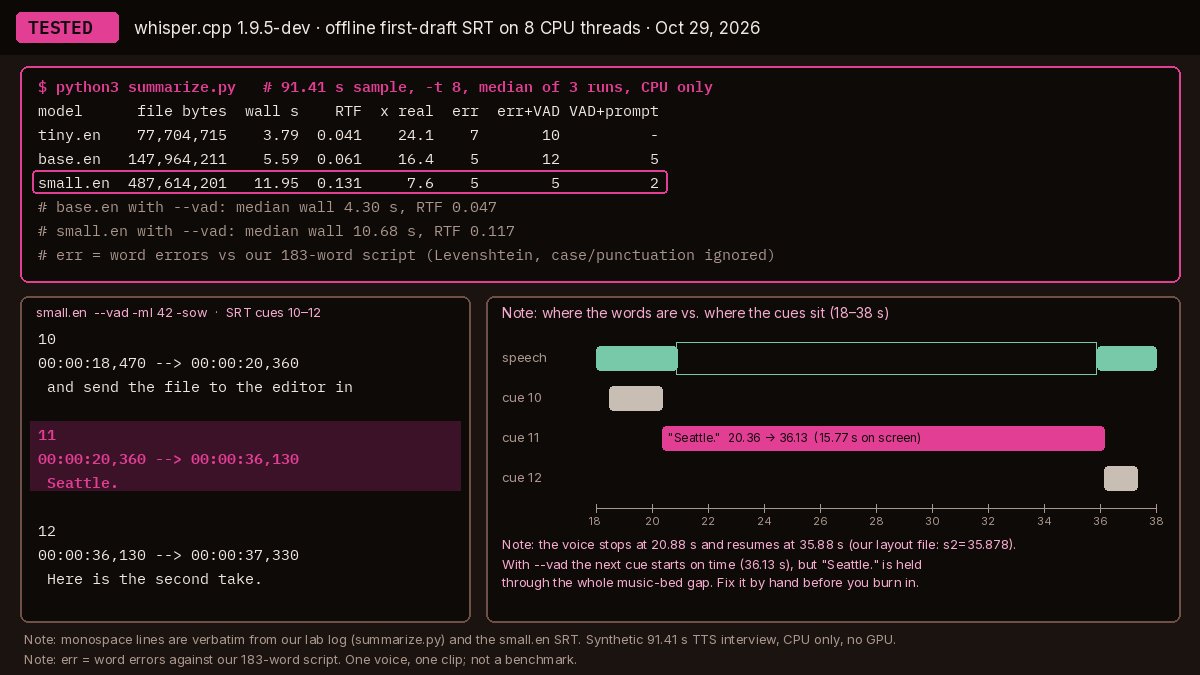
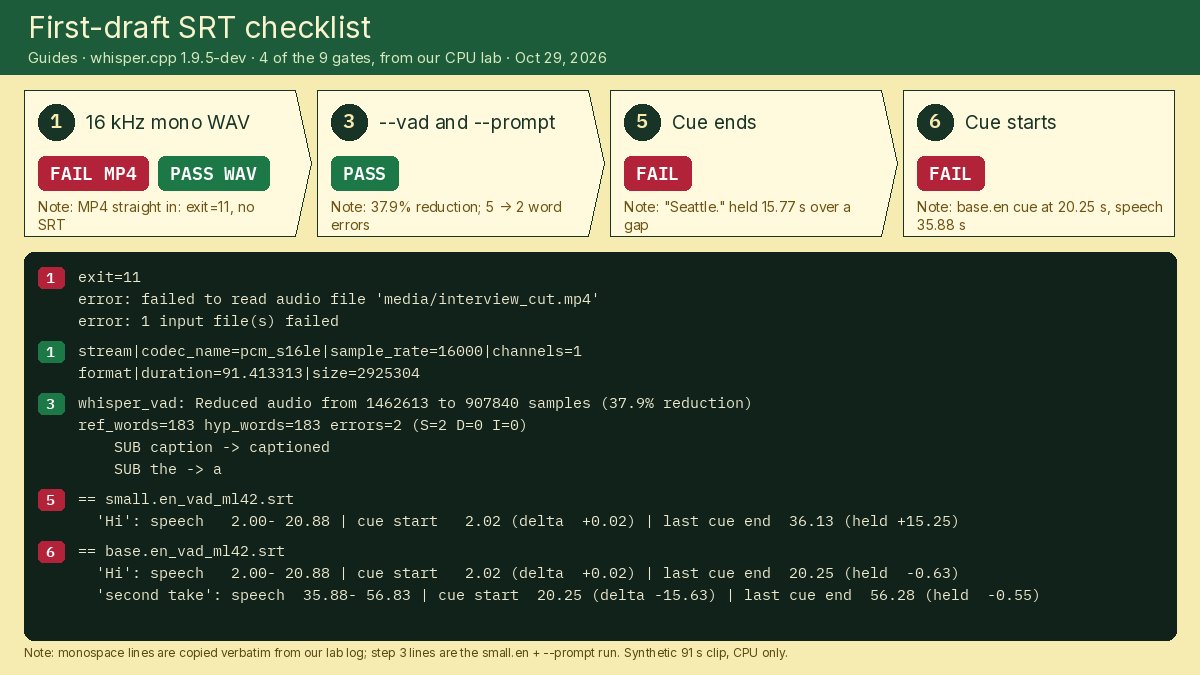
Model size is the trade you actually make. tiny.en (77,704,715 bytes) took a median 3.79 s with 7 word errors, base.en (147,964,211 bytes) 5.59 s with 5, and small.en (487,614,201 bytes) 11.95 s with 5. Left at its default 4 threads, base.en took 6.35 s, so set -t to your core count. No model spelled our two guest names right out of the box. One --prompt line listing them took small.en (with VAD and -ml 42 -sow) down to 2 errors with all nine checked names in the right case; base.en with the same flags went from 12 to 5.
The input step is where a first run usually stops. The MP4 straight from the timeline failed with failed to read audio data, exit code 11, and no SRT. The 48 kHz, 24-bit stereo WAV master was accepted and gave an SRT identical (diff -s) to the one from a 16 kHz mono conversion, even though the README still says whisper-cli runs only with 16-bit WAV files. We convert every time anyway: ffmpeg -i interview.mp4 -vn -ar 16000 -ac 1 -c:a pcm_s16le interview_16k.wav.
Timing needs a human pass. Without VAD, tiny.en and small.en started parts two and three at exactly 30.00 and 60.00 s, which is 5.88 and 11.83 s before anyone spoke. --vad with the Silero v6.2.0 model moved those starts to within 0.25 s, but small.en then kept the last cue before each gap on screen through it: "Seattle." ran from 20.36 to 36.13 s. VAD also pushed base.en from 5 to 12 word errors. Neither gap produced invented words or a repeat loop on this clip. -ml 42 -sow took small.en from 17 cues to 34, still one line per cue, longest 46 characters.
Limits from those runs: One clean synthetic voice on one 91.41 s file, so the error counts compare settings on our input; they are not an accuracy figure for your recordings. No GPU backend (CUDA, Metal, Vulkan, Core ML) was run, and no Windows or macOS build or laptop CPU; our server CPU will likely be faster than most laptops. Non-English and mixed-language speech, the multilingual models, medium, large, turbo and quantized models, real voices with accents, crosstalk or room noise, files longer than 91 s, MP3, FLAC, OGG and 44.1 kHz input, speaker labels, Subtitle Edit's built-in whisper.cpp front end, and -nth/-et/-sns tuning were not tested.
The full lab: three model timings and word errors, MP4 vs 48 kHz WAV input, what --vad did to cue starts and ends, -ml 42 -sow line splits, and the --prompt line that fixed the guest names.
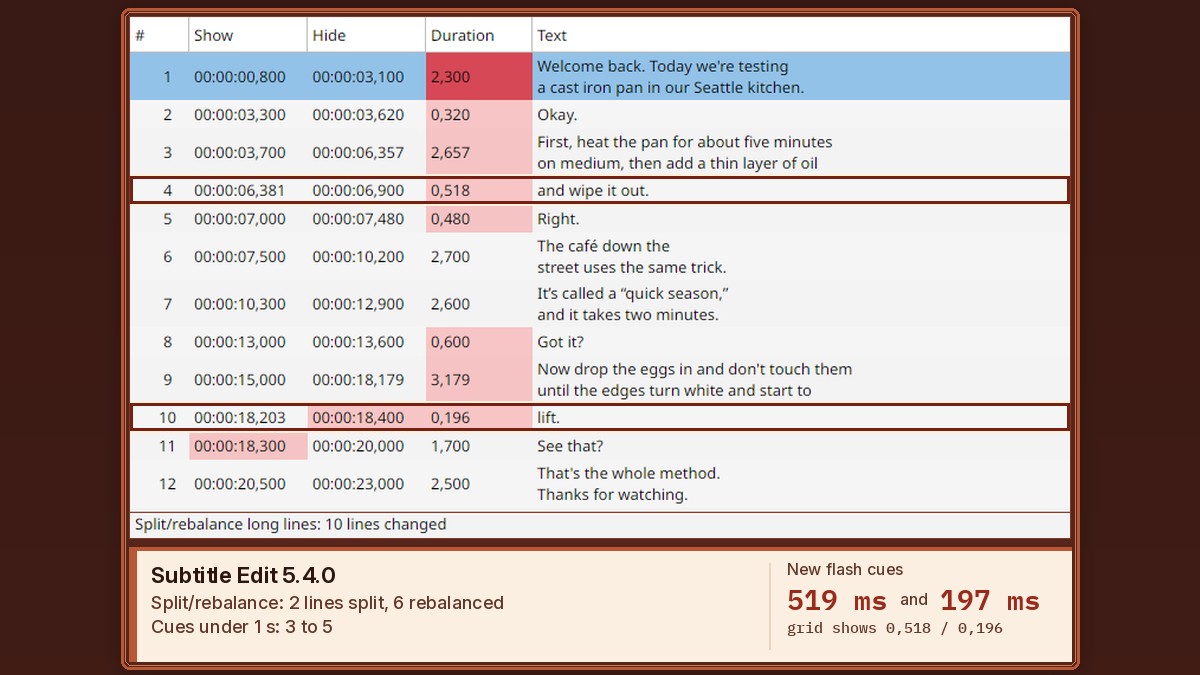
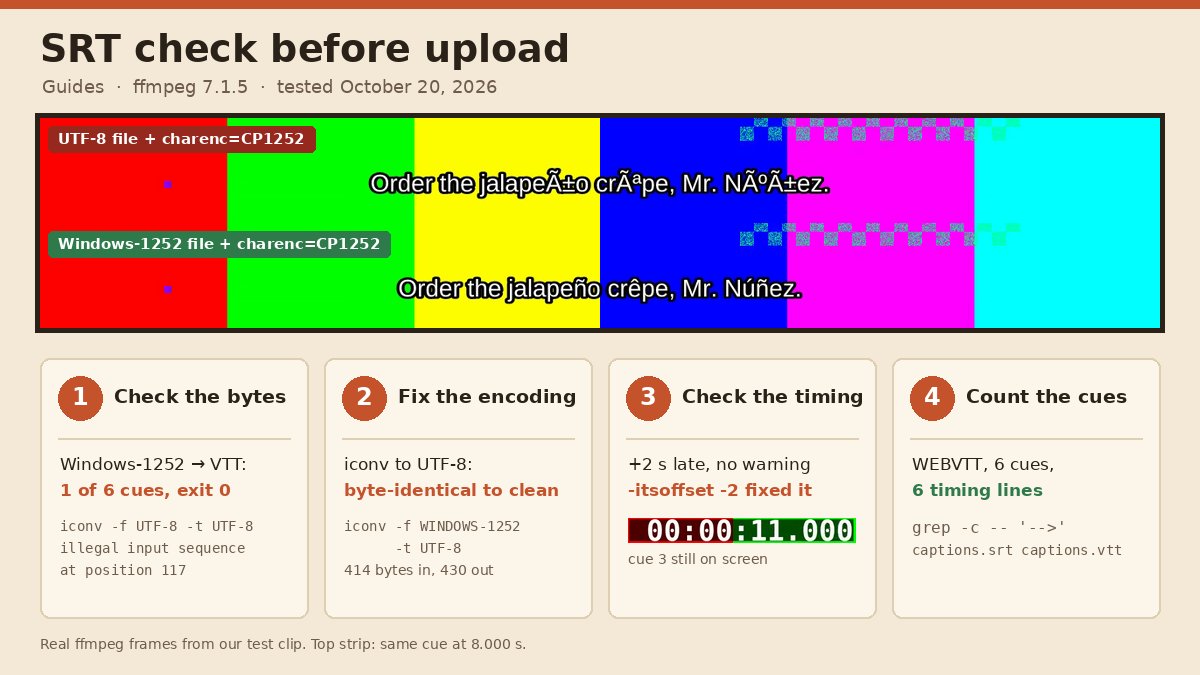
The commands from our lab in order: convert to 16 kHz mono WAV, set -t to your cores, add --vad and a --prompt with the names, split with -ml 42 -sow, then check each cue for held ends, early starts, short flashes and [BLANK_AUDIO].
The README describes whisper.cpp as a plain C/C++ implementation of OpenAI's Whisper speech recognition model, lists CPU-only inference among its features, and the repo carries an MIT license. There is no installer on the path we used: clone the repo, build whisper-cli with CMake, then download a ggml model (we took tiny.en, base.en and small.en from the project's Hugging Face page). The README's quick start converts input to 16-bit WAV with FFmpeg; whisper-cli -h on our build listed flac, mp3, ogg and wav as supported audio formats. VAD needs a second download: the README documents --vad with -vm pointing at the Silero model, and our ggml-silero-v6.2.0.bin was 885,098 bytes.
We built only on Debian 13, with zig's clang 22.1.8 because the box had no g++. The default shared-library build crashed with free(): invalid pointer on every run; -DBUILD_SHARED_LIBS=OFF fixed it, and we read that as our toolchain rather than whisper.cpp. The README lists macOS, Windows, Linux and other platforms; we ran none of them except Linux. Write down the commit you build, since speed and input handling can change between versions.